The 3 Accessory Movements Every CrossFitter is Missing
Dr. Lee Pinkham, DC
Short version: CrossFit trains one plane of movement really well and under-trains three things - supinated (palms-up) pulling, side-to-side and rotational work, and single-limb movements. Add those back into your warm-ups, cool-downs, or accessory pieces and a lot of those nagging injuries settle down. Here’s each gap and the exact movements to fix it.
I‘ll start out by saying that I love CrossFit, and am a huge fan of the methodology. For almost 10 years now it has been the foundation for how I train, and I absolutely love it. I believe I am in the best shape of my life - whether that’d be through strength, cardio, or my body’s ability to move itself through space (gymnastics).
I believe that community drives most people - and when you find a community within CrossFit - fitness never feels like a chore anymore. It becomes engrained in your life, your family, your friends, and most importantly, your actions.
I also believe CrossFit doesn’t bring any more injuries than another modality of fitness - contrary to popular belief. In fact, there is research to prove it.
But there are a few things that CrossFit is missing - and it’s what got me thinking about building a CrossFit Accessory Program.
And before we dive into what those are - I do think my resume in this space holds some weight. Over the past several years, I’ve worked with several of the fittest CrossFit Games athletes and teams in the world. Those names include:
Dallin Pepper. James Sprague. Ty Jenkins. Brent Fikowski. Fee Saghafi. Alexis Raptis. Danielle Brandon. Lena Richter. Janie Cheverie. Emma Lawson. Emma Cary. Rebecka Vitesson.
And several other semi-final athletes.
I say that to say… that doesn’t mean you should blindly trust me. You should always vet your sources before fully trusting someone. These athletes do trust me, and the most common thing I hear from them is: “It’s nice that you get it.”
So. With that said - I believe CrossFit programming as a whole is amazing. But, it has 3 major areas for improvement - things that can simply be added into warm-ups, cool-downs, or accessory pieces.
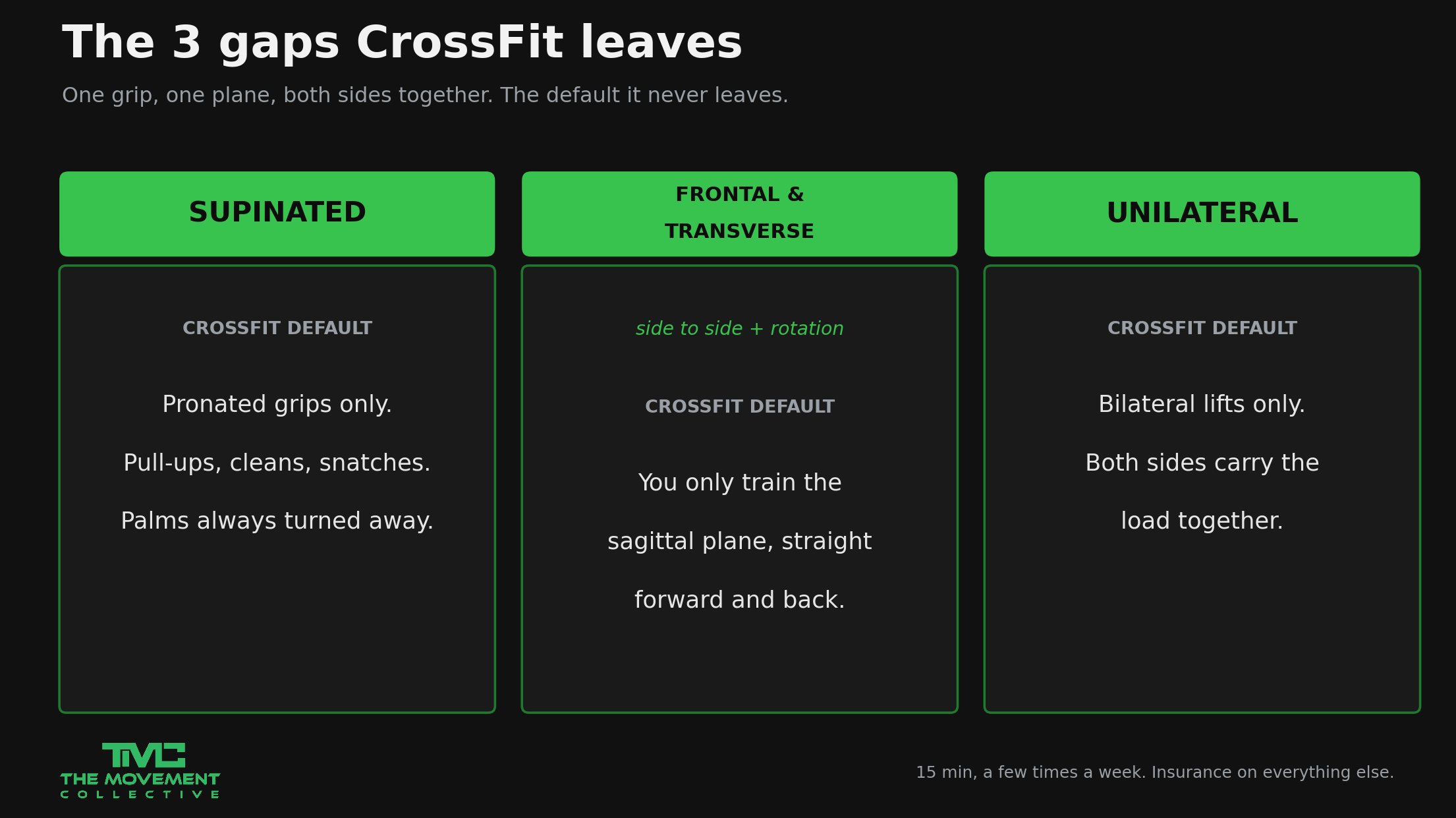
Gap 1: Not Enough Supinated (Palms-Up) Pulling.
Flip your hands over. Problem solved.
Nearly every thing in CrossFit is a pronated grip (Palms facing away). All barbell work. All rig work. All machine work. When do you ever turn your hands around?
I realized this one day when I had chin-ups in my workout. I looked up at the bar and hesitated before I jumped up - because it felt awkward to turn my hands towards me. That’s crazy!
And with the CrossFitters I worked with - I noticed a lot of them were coming in with inner elbow pain. Well from an anatomical perspective - it actually makes a lot of sense. The pronators and flexors all originate on that inner elbow - if they are overworked and too tight - they could start causing some issues. And on the flip side if the extensors don’t get enough love, they could start having trouble too.
What almost never gets trained is the supinated position, palms up. Chin-ups, supinated rows, curls, anything that asks the biceps to pull with the forearm turned over.
And because those muscles cross the elbow, an athlete who has thousands of pronated reps and almost no supinated strength ends up with an elbow that’s carrying load it was never built up to handle.
The angry elbow so many people have is often just a forearm and a biceps that never got trained in the one position that loads them directly.
If you want the secret to our program - it’s really just spending more time supinated through exercise. Some of the movements you’d see are: supinated ring rows, supinated rows, chin-ups, supinated bar hangs, bicep curls (yay).
Of course in the program they are a lot more structured & flow well - but you get the picture.
Onto the next one.
Gap 2: Not Enough Frontal and Transverse Plane Work.
Movement happens in three planes. The sagittal plane is forward and back. The frontal plane is side to side. The transverse plane is rotation, twisting one way or the other.
CrossFit lives almost entirely in the first one.
Think about it - when do you rotate? Maybe a few russian twists here and there? Or what about going lateral… maybe a few cossack squats in the warm-up?
Everything is forward and backwards or up and down. Squat down and up. Deadlift up and down. Run forward. Row back. Wall balls. Pretty much everything is saggital, and the side-to-side/rotational planes barely get touched.
And what I’ll see with clients is that they are incredibly strong and stout in that saggital plane, but they are see me because the rotated funny when picking a toy up off the floor.
If you never train rotation or lateral movements - what makes you think you will be strong there?
Now I’m not saying you will never throw your back out picking up that toy if you do train rotation… but I am saying it’s less likely to happen.
The movements you’re missing:
For the frontal plane, cossack squats, Copenhagen planks (really all adductor work), clamshells, (really all abduction work, too).
For the transverse plane, landmine rotations, cable chops, med-ball throws… you get the idea.
And last, but not least!
Gap 3: Not Enough Unilateral Work
This one has a lot of similarities as the last one, but has enough features to give it it’s own focus.
Sure, you do lunges, single arm dumbbell cleans/snatches, and… (I’m sure there’s something else… right?).
But it’s almost always in a workout. Maybe you have lunges programmed as a strength, in which, I applaude your coach or gym.
But when’s the last time you just did a single arm strict press for quality? That’s not just a light warm-up? Or an overhead carry? Or lunging NOT in a metcon?
Been a while?
The trouble with bilateral work is that a strong side can quietly carry a weak one. You can back squat a big number while your left leg does noticeably less than your right, and the bar will never tell on you. The imbalance stays hidden right up until a movement forces one limb to work alone.
The movements you’re missing:
Split Squats. Single Leg RDL’s. Hip Airplanes (my favorite). Lateral box step-ups/downs (two birds with one stone). single-arm press. Carries. etc.
And think about it - it will only help your other lifts!
The Takeaway
Honestly, there isn’t too much I’d change about CrossFit. And really, these things that I mentioned I would add in, are really easy to add in for yourself.
That might make me a bad salesman, but it is the truth. If you feel like you have been stalling on progress because weird injuries keep popping up here and there - it could be because of this gap in your programming!
Maybe I’ll drop a CrossFit Accessory Program soon…
Frequently Asked Questions
What accessory work is missing from most CrossFit programming?
Three things: supinated pulling, frontal- and transverse-plane movement, and single-limb work. CrossFit lives mostly in the sagittal plane with both limbs working together, so those get skipped.
Why do my elbows hurt from CrossFit?
Often it’s a forearm and a biceps that never got trained palms-up. Add supinated rows, chin-ups, and curls and the angry elbow usually calms down.
What single-leg exercises should CrossFitters add?
Split squats, single-leg RDLs, hip airplanes, lateral step-ups and step-downs, single-arm presses, and carries.
References
Serner A, et al. Current clinical concepts: exercise and load management of adductor strains and long-standing adductor-related groin pain. Journal of Athletic Training. 2023.
Ishoi L, et al. The neuromuscular effects of the Copenhagen adductor exercise: a systematic review. International Journal of Sports Physical Therapy. 2021.
Youdas JW, et al. Surface electromyographic activation patterns during pull-up and chin-up grip variations. Journal of Strength and Conditioning Research.
Feito Y, Burrows EK, Tabb LP. A four-year analysis of the incidence of injuries among CrossFit-trained participants. Orthopaedic Journal of Sports Medicine. 2018.
Sannicandro I, et al. Effects of unilateral and bilateral training on strength asymmetries and performance. Journal of Sports Science and Medicine.