Pain is data, not always damage: A conversation I have daily
What pain is, and how to navigate it, is a conversation I have several times every single day.
So as you can imagine, when you say something repeatedly, you can repeat it in your sleep. So today, I’m going to have that same conversation with you.
Let me set the scene for you. Tom comes into my office because he has been having shoulder pain that is waking him up at night (sound familiar?). He says it hurts when he lifts weights, and during activities at work where he has to lift his arm overhead. He also says: “Funny thing is - it feels better when I move it.” (There’s a reason for that - give me a sec)
I’ll of course rule out any major red flags. Trauma, radiating pain, etc. After that - I’ll do my ROM (Range of Motion) assessment. (I’ll talk about that another time).
We will play with some movements, and see what patterns trigger it. There’s almost always a pattern (when the arm is overhead, behind you, etc.).
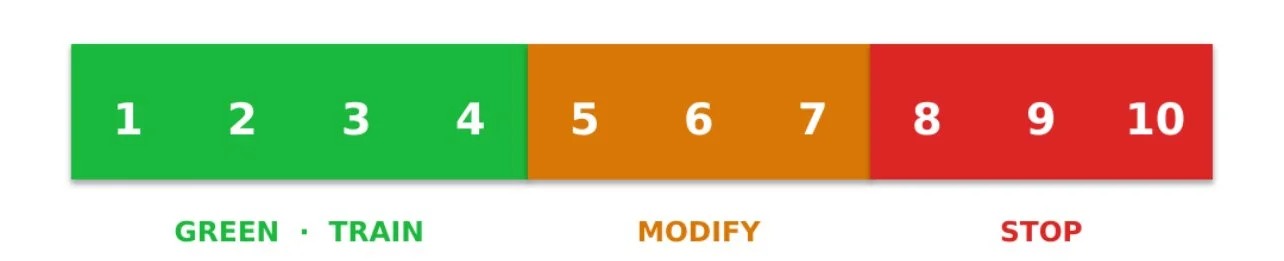
And when we establish what movements hurt it, I’ll have them define how bad it hurts. I ask all the time: “On a scale of 1-10, how bad is it?”
Why do I do this? Because I want to put an objective measure on pain. When you say “it hurts when I put my arm over my head." we have to define that. Because if it hurts a little… that’s fine. If it hurts a lot… that’s no bueno.
But if we can rate the pain, then we can learn how to manage situations that bring on pain.
On a scale of 1-10, I say keep the pain under a 4/10. During and after. Now - you know during, during, and you won’t know after, until after. But I’m okay with a little bit of FAFO. (F…Mess Around and Find Out).
Why do I do it this way? A few reasons why.
1) Because the alternative sucks and I believe it’s a cop out most of the time from clinicians. It’s saying: “You should rest.” But I hear: “I’m not sure what to do, so I know that if you rest it, you won’t hurt it. So do that.”
But how many times have you done that, only to return to those activities 2-4 months later and still having pain?
And then, you’re spiraling. “Rest didn’t help - so I guess it’s more serious than I thought, and I can’t do those things anymore.” (I’m a big believer in the Bio-pyscho-social Model of Pain - I’ll talk about that in another blog too).
(Spoiler: yes you can still do those things)
2) It means you don’t have to quit doing the things you love/want/need to do.
I mean - who doesn’t want that? And for you active people out there - isn’t that exactly what you want to hear? If you tell me that I can’t continue with an activity, I’ll tell you to give me another suggestion. And that if you think you’re right - then you better have a sound, anatomical explanation for your decision.
(Spoiler: they never do)
So what do you do?
You keep pain under a 4/10. If it’s a 5/10 when you press 95# overhead, press 85# and ask yourself the same question. Then as you establish that baseline number, let’s say 85#, then treat that like your current 1RM and build from there.
Now, in 2 weeks when you’re at 115# before it creeps over a 4/10 - it doesn’t faze you like it used to. Yes, your shoulder still might hurt, but your capacity has gone up. Your tolerance has improved.
You’re getting better.
And with my clients, I’ll pair that approach with some specific rehab & accessory work. Things to build the tolerance & capacity in low volume/high frequency settings.
Oh, and the reason why your shoulder feels better when you move it? That’s because, it’s craving movement. It doesn’t want to just sit there and do nothing - it needs to move to feel better.
Pain is complex. And there are more factors than just structural when it comes to fixing it. Sometimes, I find myself being more of a therapist than a MSK clinician. Never would’ve guessed that…
This is the first blog of many on our page. Your presence, shares, feedback & purchases of our programs, helps make this possible. You may think that you’re just one person and can’t have much of an impact - but that can’t be further from the truth!
Want to support us? Bullet Proof Programs (self-guided, $40) and Prehab Pro ($20/month with 7-day free trial) are built on these principles. Of course - check out all the tabs on our page for our full offerings!
Until next time!
Dr. Lee Pinkham, DC, A.R.T., CF-L2