Why Your Knee Tendon Needs More Load, Not Less
If your knee aches going up or down the stairs, is screaming at you if you dare jump on a box, or does the same the second you go for a jog, you’ve probably already tried the obvious thing. You rested it. You backed off the squats, skipped the runs, iced it, waited.
And it felt a little better (probably because you weren’t using it), right up until you loaded it again, at which point it picked up the conversation exactly where it left off.
For most cranky knees, rest is not the fix. Rest is the thing that quietly makes them weaker, so the next time you load them they have even less to give.
What a tendon really is
Your patellar tendon is the thick cord that connects your kneecap to the top of your shin. Every time you squat, jump, run, or walk down stairs, it takes load. That’s its job. It’s built for it.
A healthy tendon is like a spring. It stores and releases energy, and it adapts to whatever demand you place on it. Load it in a smart, progressive way and it gets thicker, stiffer, and more tolerant. Take load away and it does the opposite. It loses capacity.
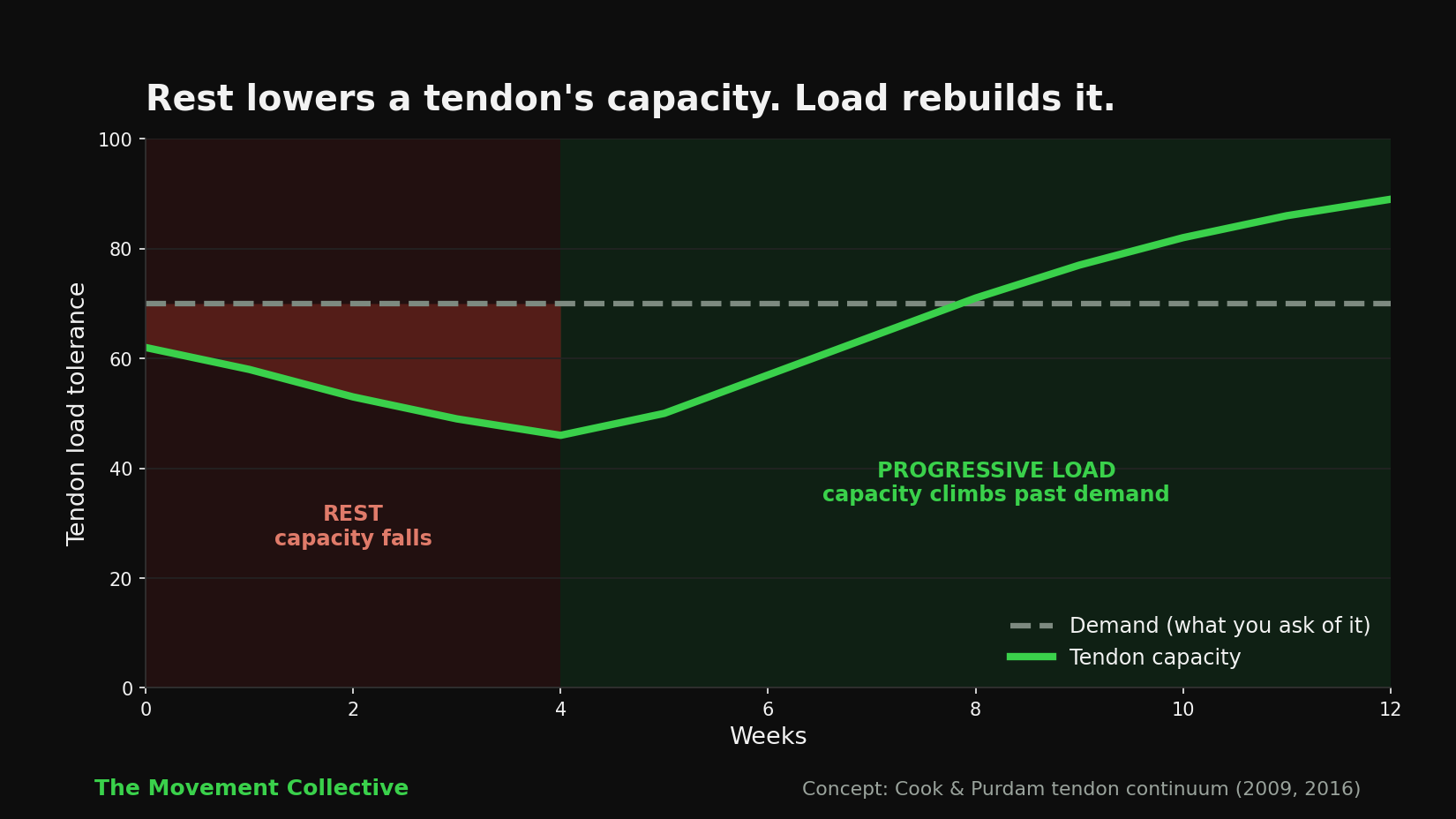
This is the single most important thing to understand about tendon pain. A tendon’s tolerance for load is not fixed. It goes up when you train it and down when you don’t.
The continuum, and why “rest” backfires
The way researchers understand tendon pain shifted with a model from Jill Cook and Craig Purdam, first published in 2009 and revisited in 2016. They described tendon pathology as a continuum rather than an on/off switch. A tendon moves along that spectrum based mostly on one thing, and it’s not age or bad luck. It’s load.
Add the right load and the tendon adapts forward. Overload it in a spike, or pull load away entirely, and it slides back toward a less capable state.
The reframe that came out of that work is the one I want you to sit with. Tendinopathy is not an injury you wait out. It’s a failed adaptation to load. The tissue got asked to do more than it was ready for, usually because of a sudden spike (you added running volume, started a new program, came back from a layoff too fast), and it fell behind. The pain is the tendon telling you the gap between demand and capacity got too wide.
Rest closes that gap from the wrong side. It lowers demand for a while, so it feels better. But it also lets capacity keep dropping. Then you return to normal activity and the gap is right back, sometimes worse, because now the tendon is weaker than when you started.
Load is the medicine, dose is everything
If load is what a tendon needs, the obvious question is how much and what kind.
This is where the “no pain no gain” crowd and the “rest it” crowd are both wrong. You don’t blast it, and you don’t baby it. You dose it.
Here’s the progression the research supports, roughly in order.
Isometrics for the angry phase. When a tendon is genuinely irritable, holding a position under load (think a wall sit, or a Spanish squat held at the bottom) lets you load the tendon heavily without the up-and-down movement that flares it.
There’s decent evidence that isometric holds can calm tendon pain in the short term while still delivering a real training stimulus. It’s how you keep loading a tendon that doesn’t yet want to move under load.
Heavy slow resistance during the rebuild. Once it tolerates holds, the workhorse is slow, heavy strength work.
Squats, leg press, split squats, done with a deliberate tempo (things like a three-second lower, a three-second rise). Heavy slow resistance has the strongest evidence for changing the tendon’s structure and its long-term capacity. It’s not glamorous. It’s a handful of hard sets, a few times a week, for longer than you’d like. It works.
Speed and spring, last. Only once capacity is rebuilt do you add back the fast, bouncy, plyometric demands (running, jumping, rebounding out of the bottom of a squat). Add those too early and you re-spike a tendon that isn’t ready. Add them at the end and they’re the finishing touch.
Notice what’s missing from that list? Total rest.
What this looks like in real life
A lifter comes in with the classic story. Their knee has been achy for a couple months, worse going downstairs, worse after sitting, feels “ok” after they get going and they pay for it later. They’ve backed way off squatting because loading it hurts, and it’s not getting better.
The instinct, the one they arrived with, is to rest it more. We do the opposite.
We find a load the tendon can tolerate today, usually an isometric hold and some slow tempo work, and we start there. It doesn’t have to be pain-free, it has to be tolerable, and it shouldn’t be worse the next morning.
Then we add a little each week. More time under the hold, harder progressions, etc.
The tendon does what tendons do when you load them intelligently. It adapts! The fix was never time off. The fix was the right dose of the exact thing they’d been avoiding.
The one rule to leave with
A knee tendon that hurts is usually not damaged beyond use. It’s under-built for what you’re asking of it. You close that gap by building the tendon up, not by waiting for it to heal on its own. Load is the signal that tells it to adapt. Take the signal away and it gets weaker.
So the next time a knee tendon starts complaining, don’t reach for two weeks of rest and hope. Reach for a load it can handle today, and build from there.
Ready to load those tendons the right way? Start with our free Knee Self-Assessment to see where you stand, then follow our Bulletproof Your Knees program to fix the weak link over 4 weeks!
References
Cook JL, Purdam CR. Is tendon pathology a continuum? A pathology model to explain the clinical presentation of load-induced tendinopathy. British Journal of Sports Medicine. 2009;43(6):409-416.
Cook JL, Rio E, Purdam CR, Docking SI. Revisiting the continuum model of tendon pathology. British Journal of Sports Medicine. 2016;50(19):1187-1191.
Rio E, Kidgell D, Purdam C, et al. Isometric exercise induces analgesia and reduces inhibition in patellar tendinopathy. British Journal of Sports Medicine. 2015;49(19):1277-1283.
Kongsgaard M, Kovanen V, Aagaard P, et al. Corticosteroid injections, eccentric decline squat training and heavy slow resistance training in patellar tendinopathy. Scandinavian Journal of Medicine & Science in Sports. 2009;19(6):790-802.