Sciatica has become a catch-all. People use it for almost any pain that shows up in the buttock or the back of the leg.
The problem is that “sciatica” is a symptom, not a diagnosis.
It tells you where the pain is. It tells you nothing about what is driving it. And the thing driving it changes everything about what you should do about it.
What the word is supposed to mean
Sciatica means pain along the path of the sciatic nerve. True sciatica, the kind your doctor means when they use the word carefully, is radicular pain. That means the pain is coming from an irritated or compressed nerve root in your low back, usually at the L5 or S1 level, often from a disc that is pressing on or inflaming that root.
Around 95% of lumbar disc herniations happen at those bottom two segments, so when a disc is the culprit, this is where it tends to live.
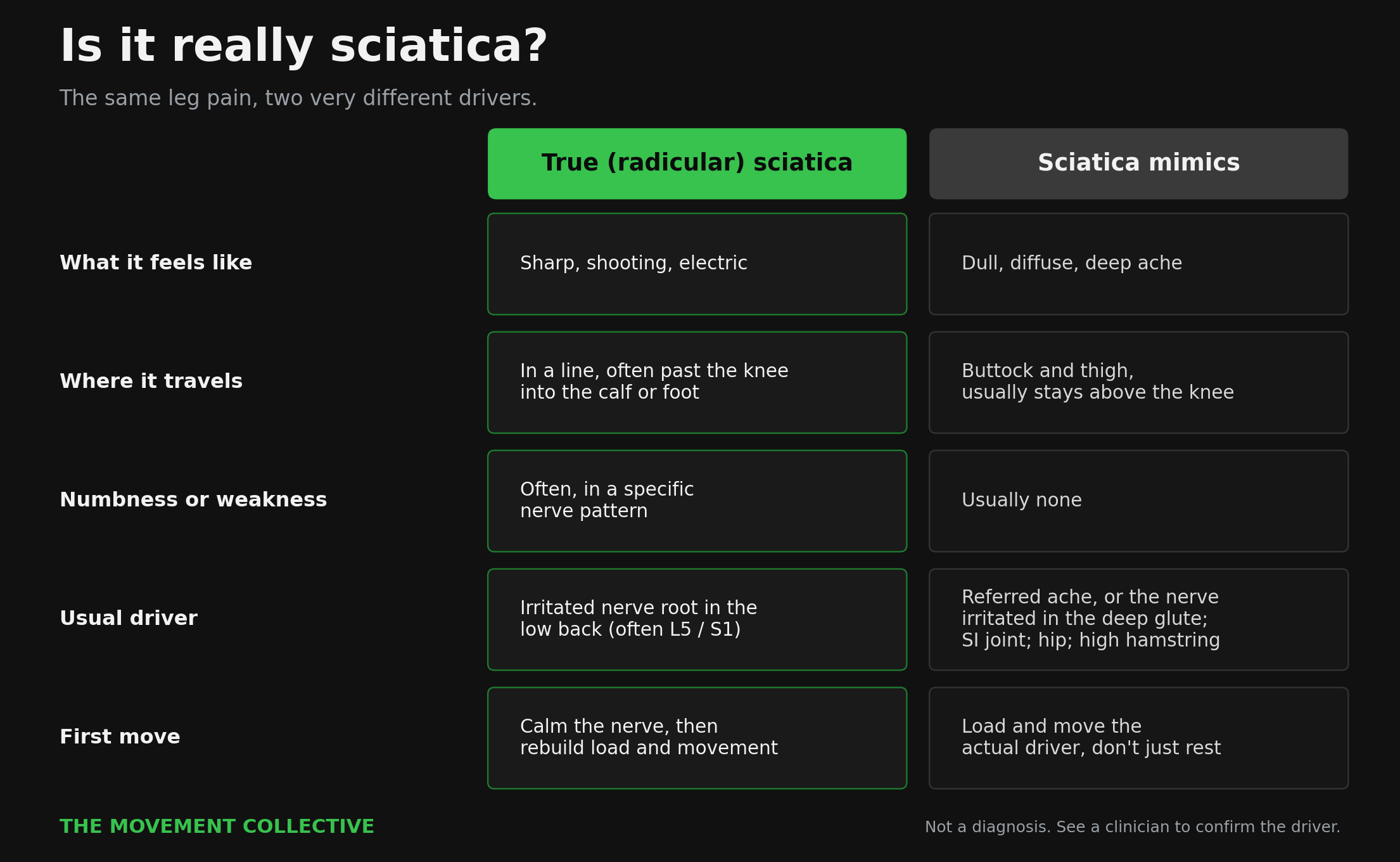
Radicular pain has a signature. It is sharp, shooting, or electric. It travels in a line, often past the knee and into the calf or foot. It frequently comes with numbness, pins and needles, or weakness in a specific pattern that matches the nerve.
The pain that looks like sciatica but comes from somewhere else
Get this… A lot of buttock-and-leg pain is not radicular at all.
The first impostor is somatic referred pain. Muscles, joints, and discs can refer a dull, spread-out ache into the glute and thigh. It does not follow a clean nerve line. It usually stays above the knee. There is no true numbness or weakness, just a deep ache that moves around. Your body is bad at telling your brain exactly where a joint or muscle problem is coming from, so it refers the signal into the neighborhood. People feel that ache in the back of the leg and reach for the word sciatica.
The second impostor is the sneaky one. Sometimes the sciatic nerve really is irritated, but not at the spine. It gets cranky further down, in the buttock, where it passes through a crowded space behind the hip alongside the piriformis and a handful of other small muscles.
Depending on which criteria you use, some form of this shows up in roughly 6 to 17% of people who come in labeled with low back pain or sciatica. It gets over-diagnosed by people who blame the piriformis for everything, and it gets missed by people who only look at the spine. Both can happen!
The reason it gets missed is worth sitting with. The standard test for sciatica is an MRI of the lower back. That scan does not even image the deep gluteal space where this entrapment happens. So the scan comes back showing a disc bulge, which most adults have anyway (you should read our last blog post if that surprises you) and the bulge takes the blame while the real irritation sits an inch or two below in the glutes.
There are other mimics too. The SI joint refers pain into the buttock. A high hamstring tendon problem sends pain into the same area and gets worse with sitting. The hip itself can throw pain backward. None of these is sciatica. All of them get called sciatica.
Why the label matters more than it seems
The label changes the treatment, and the wrong label sends people the wrong direction for months.
If you believe a disc is crushing your nerve, you brace. You stop loading. You avoid bending. You get scared of your own spine and you move less. For a cranky nerve root, some early calming down can help, but for almost everything else on this list, that response is close to the opposite of what the tissue needs.
A referred ache from a stiff joint and an irritated nerve in a tight, under-loaded hip both tend to get better with movement and load, not rest and fear.
I wrote a whole post on this trap with imaging. The short version is that a disc finding on an MRI is common in people with zero pain, and the scan cannot see the deep gluteal space at all, so it is a weak place to hang your whole story. Your symptoms, your movement testing, and your history carry far more information than the picture does.
How I sort it out
When someone comes in with leg pain, I am asking a specific set of questions before I start anything. Where exactly is it? How far down does it go? Does it stop above the knee or run past it? Does it feel like an ache or like electricity? Is there numbness, tingling, or weakness? What makes it worse: sitting, bending forward, walking, or direct pressure right on the glute? What makes it better?
Those answers help paint the picture. Pain that runs past the knee in a clean line, feels electric, and comes with numbness or weakness leans toward a true nerve root problem. Pain that sits in the buttock and thigh, feels like a deep diffuse ache, and flares with direct pressure or certain hip positions leans toward a referred or entrapment source. Then I test movement and load to confirm which one is reproducing the symptom.
None of this is a substitute for getting examined. It is how I decide whether we are dealing with a spine problem, a hip problem, or a nerve that is annoyed somewhere along its travels. Those three roads lead to three different plans.
What this means for you
Four things to take away.
Sciatica is a symptom, not a diagnosis. If someone hands you that word, the useful question is not how do I treat sciatica, it is what is driving this, and how do we know?
Where it travels and what it feels like tells you a lot. Past the knee, electric, with numbness or weakness leans toward a true nerve root. Buttock and thigh, dull and diffuse, leans toward a referred or entrapment source. It is not a perfect rule, but it is a good first filter.
Most of it gets better. Around 80% of sciatica settles within about eight weeks and roughly 90% within a year, usually without surgery. The plan is rarely just rest, and it is almost always some version of the right movement and load for the driver.
Know the red flags. Loss of bowel or bladder control, numbness in the saddle region, or progressive weakness in the leg are not wait-and-see symptoms. Those need to be seen urgently. Everything else usually has time and options.
Lastly…
If your leg pain has been called sciatica and the plan has been to rest, brace, and wait, and it is not getting better, that is often a sign the label is wrong, not that your body is broken!
The nerve, the joint, and the muscle each ask for something different. Figuring out which one is talking is most of the work.
If you want a starting point, our free self-assessments walk you through some of the same movement checks I use to sort this out. And if you already know movement and load are your missing piece, that is exactly what our programs are built around.
References
Martin HD, et al. Deep gluteal syndrome, an overlooked cause of sciatica. Journal of Hip Preservation Surgery, 2015.
Probst D, Stout A, Hunt D. Piriformis syndrome: a narrative review of the anatomy, diagnosis, and treatment. PM&R.
Dydyk AM, Khan MZ, Singh P. Radicular back pain. StatPearls.
Koes BW, van Tulder MW, Peul WC. Diagnosis and treatment of sciatica. BMJ, 2007.